
The endpoints are not the middle
The Wan2.1 release log records FLF2V—first-last-frame video generation—on 17 April 2025. That capability maps cleanly to a familiar filmmaking problem: a cut needs a visual bridge between two fixed compositions. But matching endpoint images is not the same as designing action. The audience still needs to understand what moves, when it starts, what is occluded, where weight shifts, whether screen direction is held, and how the camera participates. A start frame and end frame can make a seductive promise that the middle will be coherent; treat them instead as two constraints on a written beat. [s1][s2][s3] [s1] [s2] [s3]
Write the bridge brief in six lines. Line one: start-frame facts that cannot change—subject placement, wardrobe, prop state, lens feel, light direction and axis. Line two: end-frame facts. Line three: the one action, expressed as an observable verb, such as ‘the actor sets the case on the table’; avoid compound instructions. Line four: timing, for example ‘hold for eight frames, move through center, settle for twelve.’ Line five: camera behavior, either locked or one named move. Line six: continuity hazards: fingers must stay attached to handle; lid remains closed until contact; actor exits camera right. This is a planning method, not a finding about the model. It gives the editor a way to reject a bridge whose endpoint resembles the reference but whose in-between motion introduces a new story fact. [s1][s2] [s1] [s2]
For a practical test, take an existing edit with a motivated cutaway gap. Export only the reference frames needed for start and end, never a grab bag of all available stills. Generate candidates, then put each at the required duration directly between the actual neighboring shots. Reject on the first continuity break rather than rescuing it with speed ramps or sound camouflage. If a usable version exists, retain both endpoint assets, their source shots, the beat brief, output and selection reason. If no version works, the result has still answered something useful: the bridge needs a conventional insert, a re-blocked shot or a different editorial transition. Do not claim that FLF2V guarantees interpolation, physical accuracy, identity consistency or a rights outcome; Wan’s project material documents the release, not this publication’s independent test. The 2025 lesson is small but durable: endpoints constrain a bridge, while a shot brief supplies its narrative middle. [s1] [s2] [s3]
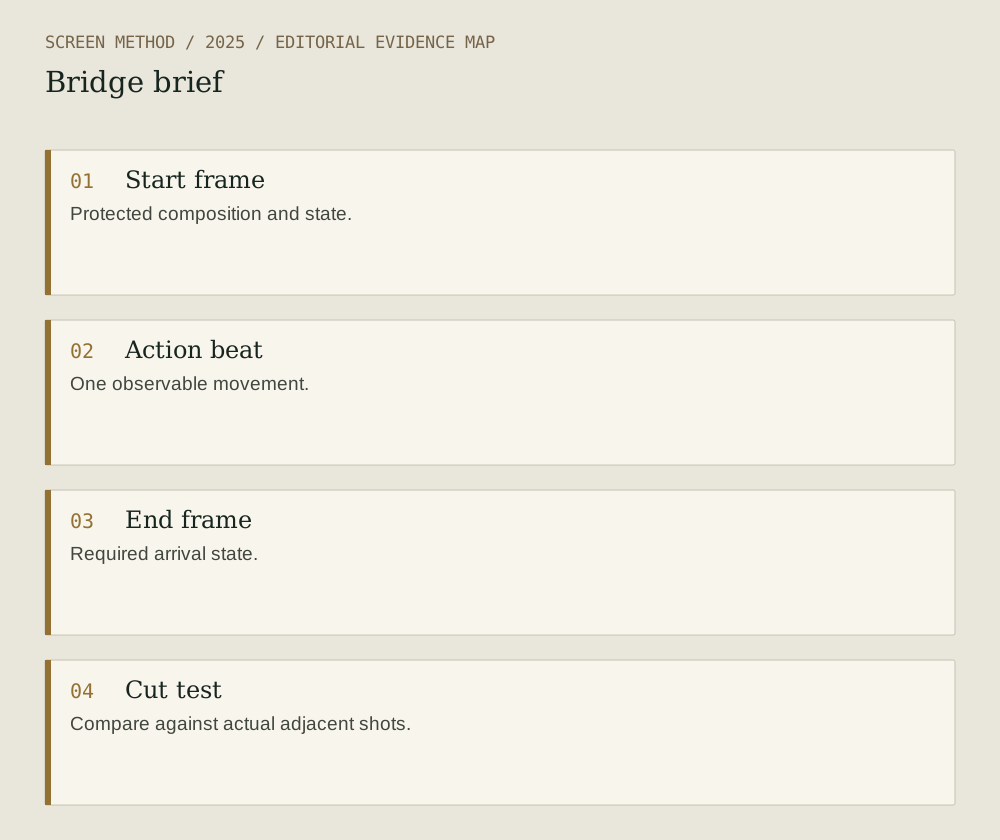
Diagram provenance
Original Screen Method editorial diagram, prepared 2026-09-19 from the cited evidence. This is an explanatory synthesis, not a product interface, documentary image or test result. No third-party artwork copied; no external image permission required for this drawing.
- Start frame Protected composition and state.
- Action beat One observable movement.
- End frame Required arrival state.
- Cut test Compare against actual adjacent shots.
Sources & limits
Editorial workflow, not a model test or guarantee of in-between motion.
- Alibaba Wan Team — Wan2.1 repository
Source date: 2025-04-17. Retrieved 2026-09-19. FLF2V release record.
- Alibaba Wan Team — Wan2.1 technical report
Source date: 2025-03-21. Retrieved 2026-09-19. Model research context.
- Alibaba Wan Team — Wan2.1 project page
Source publication date not established. Retrieved 2026-09-19. Official project context.
Preparation: 2026-09-19. Site publication: not yet published. Source dates are not publication dates for this article.