
Separate availability from readiness
The Wan2.1 repository records the release of inference code and weights on 25 February 2025, later integrations and a technical report. That is an important kind of publication: a team can inspect a repository, model card, license and its own runtime rather than relying only on a hosted interface. It does not mean a crew can promise a client that it has a usable video workstation. The first production question is mundane: can this exact machine reproduce one defined test with documented versions, storage location and output settings? The repository’s release log is evidence of a project’s public assets; it is not a guarantee about speed, quality, compatibility, safety or licensing for a particular project. [s1][s2][s3] [s1] [s2] [s3]
Make a local-model intake sheet with five parts. First, pin the repository revision, model variant and download hash; do not call an unpinned ‘latest’ download a stable show tool. Second, record hardware, operating system, CUDA or equivalent runtime, dependency lock file, free disk and an output directory outside the source checkout. Third, run a fixed scene test: a ten-second storyboarded insert with a saved prompt, seed if exposed, one reference image, duration, frame rate and resolution. Fourth, log wall-clock generation time and every error or manual recovery, without turning one result into a performance claim. Fifth, identify who can update the model, who approves an output and how a rollback happens if a new dependency changes results. This makes the difference between an experiment someone can repeat and a private desktop state nobody can reconstruct. [s1][s2] [s1] [s2]
The creative benefit of the sheet is restraint. A director can decide whether local generation is for early previs, a background plate experiment, a research comparison or a deliverable candidate. Each has a different acceptance threshold. For a previs test, a readable camera path may be enough; for a final insert, the team must also inspect cadence, artifacts, color handoff, rights, disclosure and adjacent-shot continuity. Preserve the model’s stated license separately from the rights status of your input images, performances and output use; ‘open’ does not flatten those questions. We have not installed, executed or benchmarked Wan2.1, and this draft makes no current hardware, cost, throughput, safety or licensing conclusion. It is a retrospective workflow derived from the project’s 2025 public record. The practical point is modest: before a model becomes a line item, make one reproducible test scene and one recoverable workstation record. [s1] [s2] [s3]
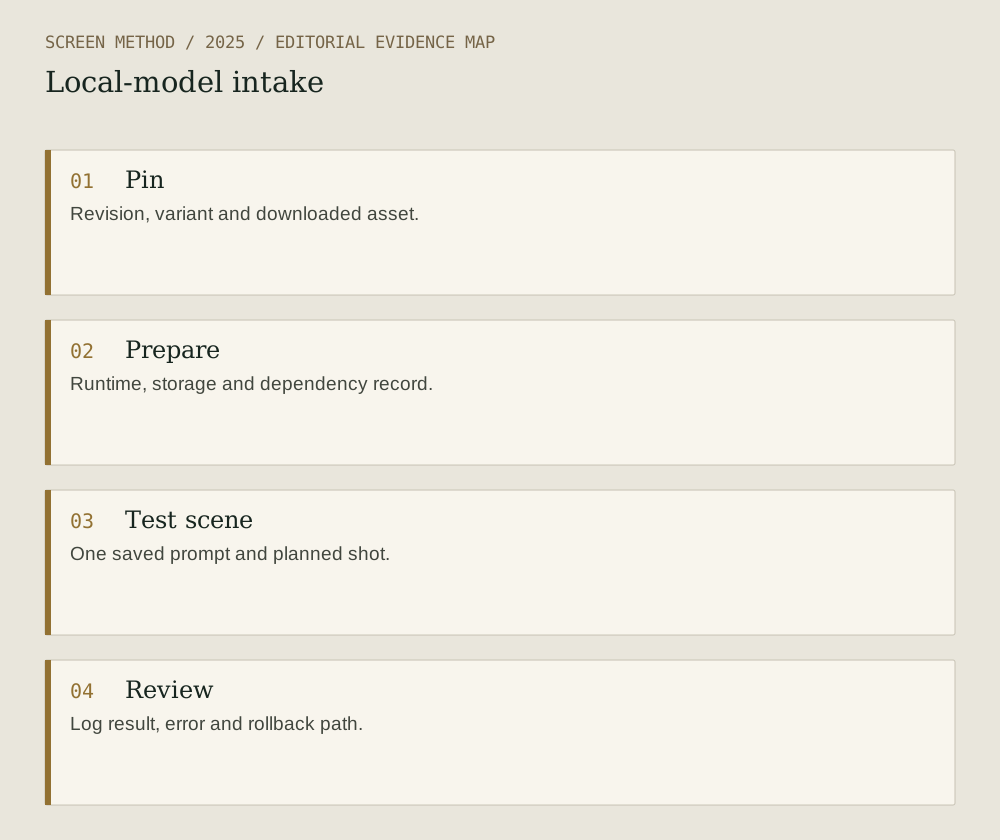
Diagram provenance
Original Screen Method editorial diagram, prepared 2026-09-19 from the cited evidence. This is an explanatory synthesis, not a product interface, documentary image or test result. No third-party artwork copied; no external image permission required for this drawing.
- Pin Revision, variant and downloaded asset.
- Prepare Runtime, storage and dependency record.
- Test scene One saved prompt and planned shot.
- Review Log result, error and rollback path.
Sources & limits
No local installation or benchmark was performed; license and deployment suitability need project-specific review.
- Alibaba Wan Team — Wan2.1 repository
Source date: 2025-02-25. Retrieved 2026-09-19. Release log, code and weight availability.
- Alibaba Wan Team — Wan2.1 technical report
Source date: 2025-03-21. Retrieved 2026-09-19. Research context and stated system design.
- Hugging Face — Wan2.1 Diffusers documentation
Source publication date not established. Retrieved 2026-09-19. Implementation-facing documentation.
Preparation: 2026-09-19. Site publication: not yet published. Source dates are not publication dates for this article.