
Consistency is a production definition
HunyuanCustom’s May 2025 paper presents a multimodal customized-video framework intended to support image, audio, video and text conditions while emphasizing subject consistency. The HunyuanVideo project release log records the related public release. These materials are evidence of a research and code publication, not an agreement on what a production means by ‘the same character.’ A model may preserve a broad face, silhouette or color palette while losing the scar, costume cut, age cue, role-specific prop or performance quality that makes the person narratively legible. Define those facts before viewing an output. [s1][s2][s3] [s1] [s2] [s3]
Use a character brief with three tiers. Tier one contains protected identifiers: approved likeness or original design, wardrobe version, hair, facial marks, hero prop, body scale and permitted age range. Tier two contains scene variables: lighting, weather, pose, lens, distance and emotional state. Tier three contains exclusions: no new jewelry, no logo substitution, no period change, no additional limbs, no child/adult shift and no dialogue outside the approved line. Attach the exact reference assets and identify their source. For a two-character conversation, do not ask a single global instruction to keep everyone consistent; make a brief for each character and a separate staging map for their relative positions. A simple rehearsal is a silent, five-second reaction shot with no camera move. If the design fails there, adding a dramatic move or sound condition will not make review easier. [s1][s2] [s1] [s2]
At review, score only the protected identifiers first. Put the reference asset and output side by side at the same approximate framing; then inspect a midpoint frame and the cutback in the next shot. Only after identity passes should the team debate atmosphere or novelty. Document whether the source was an original asset, an authorized performer asset, or a third-party reference pending clearance. Research-paper language about comparative results is not a release guarantee, and it should not be turned into a claim that character likeness is legally safe or practically solved. We have not executed HunyuanCustom or reproduced its experiments. This editorial guide makes a narrower proposition: when a tool offers several condition types, a character brief gives the director, editor and producer one shared definition of what may vary and what would break the character before that ambiguity reaches the timeline. [s1] [s2] [s3]
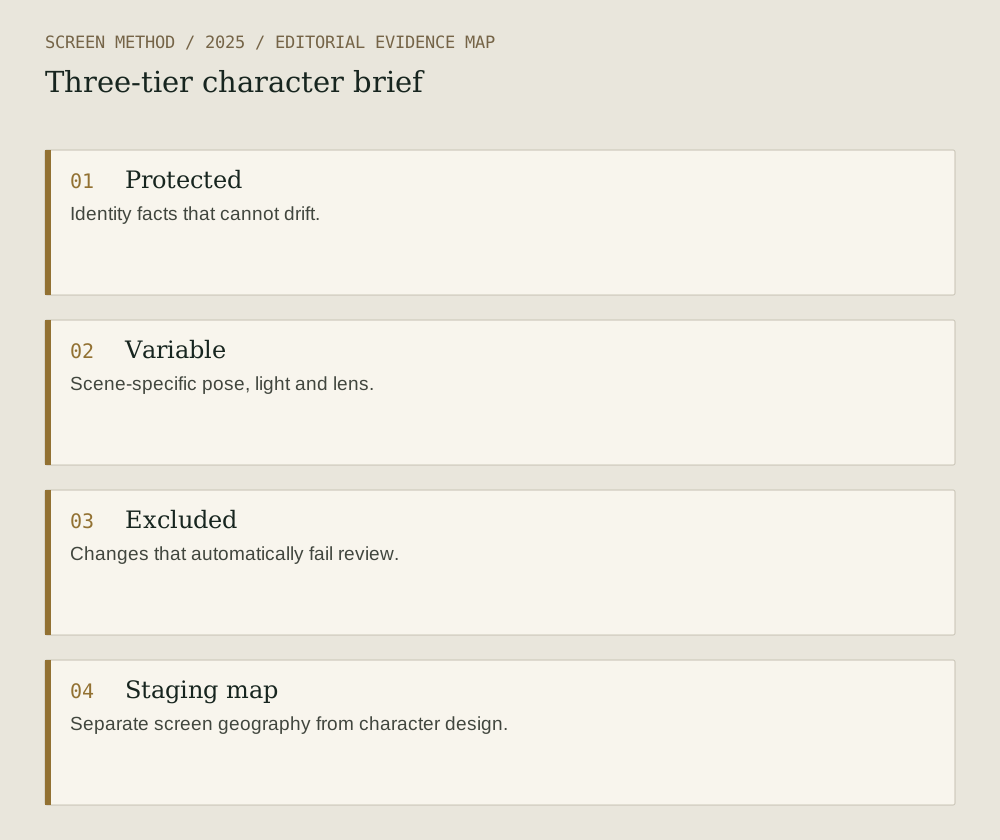
Diagram provenance
Original Screen Method editorial diagram, prepared 2026-09-19 from the cited evidence. This is an explanatory synthesis, not a product interface, documentary image or test result. No third-party artwork copied; no external image permission required for this drawing.
- Protected Identity facts that cannot drift.
- Variable Scene-specific pose, light and lens.
- Excluded Changes that automatically fail review.
- Staging map Separate screen geography from character design.
Sources & limits
Research claims are not independently reproduced; no likeness or clearance determination.
- Tencent Hunyuan — HunyuanCustom: A Multimodal-Driven Architecture for Customized Video Generation
Source date: 2025-05-07. Retrieved 2026-09-19. Research scope and condition types.
- Tencent Hunyuan — HunyuanVideo repository
Source date: 2025-05-09. Retrieved 2026-09-19. Release record.
- Tencent Hunyuan — HunyuanCustom project
Source publication date not established. Retrieved 2026-09-19. Official project availability.
Preparation: 2026-09-19. Site publication: not yet published. Source dates are not publication dates for this article.