
The shot
Isolating a moving subject from its background, and erasing an unwanted object across a clip, are two of the oldest problems in visual effects, traditionally solved by manual rotoscoping and tracking. Runway's help center, retrieved 16 September 2026, shows how the company has documented automating both tasks, and how quickly its own tooling for them has changed. A standalone Inpainting tool and a separate Remove Background tool, both aimed at exactly this class of work, were retired on 30 July 2026 according to Runway's own notice, replaced by a single prompt-driven tool called Edit Studio built on the company's Aleph 2.0 model.
What the documents show
The retired Inpainting article is unusually candid about failure modes for a vendor document. It describes the tool as one that lets a user automatically remove unwanted objects by brushing a mask over the subject, but lists circumstances that cause artifacting in the preview and export, attributing them to the model needing to invent its own visuals in situations where the clip provides little data to go off of. Named failure cases include extreme camera or subject motion, an object crossing extreme depth-of-field boundaries, an object briefly covering the entire frame, and attempts to reconstruct occluded limbs, which the article states no existent generative AI model can yet fully regenerate with accurate anatomy. This is the vendor's own documentation naming its limits, not an independent test, but a more self-critical account than most feature pages offer.
The workflow
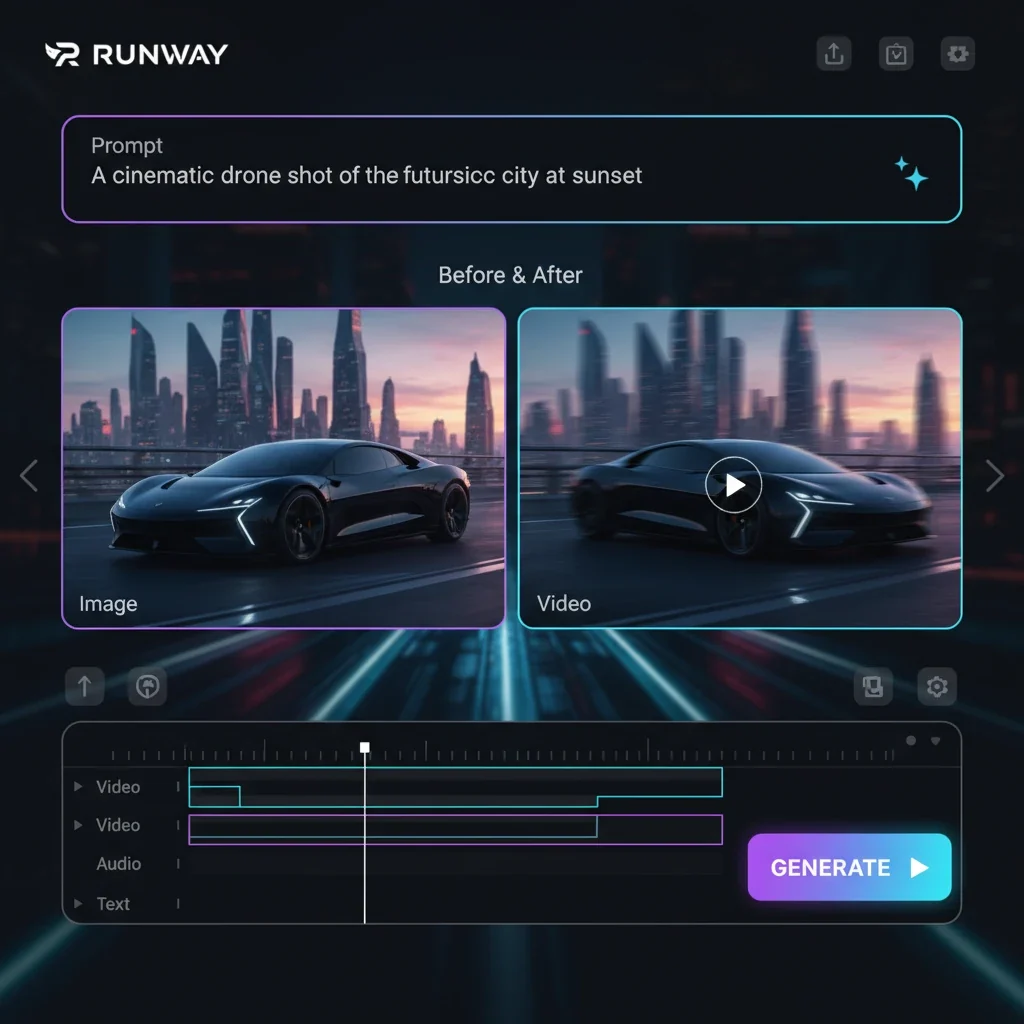
Under the retired tool, an editor imported a clip, brushed a mask over the object to remove across keyframes, previewed the result, and exported once satisfied; Runway's own guidance recommended high-quality, short clips with the masked subject kept mostly on-screen. Under the current Edit Studio, an editor instead selects a keyframe and writes a short text prompt describing the change, removing an object, swapping a background, or replacing an element, previews the resulting still, and generates the full clip from that edited frame, within Edit Studio's documented limits of 2 to 30 seconds and up to ten cuts.
What the tool does not change
Neither the retired nor the current documentation claims the software removes a compositor's review pass. The Inpainting article's own list of failure modes was effectively a checklist of situations calling for manual cleanup or a different tool entirely, and Edit Studio's workflow, previewing a single edited keyframe before generating a full clip, is built around a human judging that preview before committing to the result.
- Does the shot fall into one of the specific failure modes Runway's own documentation names, such as an object briefly filling the frame?
- Is the removed object being covered by plausible background, which the retired documentation says works better, or imagined entirely, which it says works worse?
- Has the current tool's documented length and cut-count limit been checked against this shot before scheduling the work?
Runway's own retired documentation for object removal was more forthcoming about failure conditions than most vendor pages, and those documented failure modes remain a reasonable checklist even now that the underlying tool has changed names.
Sources & reading trail
Runway's own retired help article documenting how the standalone Inpainting tool removed objects by masking, and naming the specific circumstances that caused visible artifacting.
Source published: Not established · Retrieved: 16 September 2026
Runway's current help article documenting Edit Studio, the prompt-based tool that replaced the standalone Inpainting and Remove Background tools.
Source published: Not established · Retrieved: 16 September 2026
Runway's own notice that the dedicated background-removal tool was retired on 30 July 2026 in favor of Edit Studio.
Source published: Not established · Retrieved: 16 September 2026
Documentation, agreements and rulings establish the note; the workflow reading is Screen Method editorial analysis. This retrospective draft does not imply the site published on the event date.