
The shot
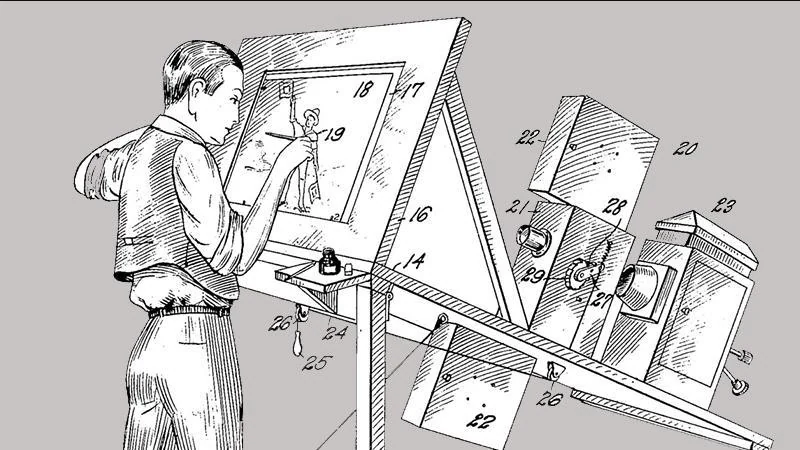
Before any software carried the name, the rotoscope was a physical machine. Animator Max Fleischer filed a patent application on 6 December 1915 for what he called a method of producing moving-picture cartoons; the patent, US1242674A, was granted on 9 October 1917. It describes a device that projects live-action film frames one at a time onto a translucent surface so an artist can trace the figures directly, then advance to the next frame and repeat the trace.
What the documents show
The patent itself is the primary record: it names the apparatus's purpose as overcoming the difficulty of maintaining 'accuracy and realism in the relative positioning of the moving object in successive cartoons,' and its drawings show a projector aimed at translucent sheets an artist traces by hand, one frame at a time. The document covers a mechanical and optical arrangement; it makes no claim to any automated or computational method, because none existed in 1917. A Library of Congress press release from December 2024, announcing the Fleischer studio's KoKo's Earth Control was added to the National Film Registry, independently credits 'Max and Dave Fleischer' with 'rotoscoping' as one of the studio's contributions — evidence that the technique, and the name, trace back to this device.
The workflow
The patent's own description lays out a per-frame loop: project one frame, trace the figure by hand onto a sheet, advance the film one frame, trace again. Every line in the resulting cartoon was drawn by a person looking at a projected reference image; the machine's only job was to hold the image steady and advance it on command. The Library of Congress record adds that the technique became closely associated with the Fleischer studio's characters, including Betty Boop, Popeye and KoKo the Clown, across the 1920s and 1930s — meaning the mechanical process described in 1917 underwrote a recognizable body of commercial animation.
What the tool does not change
Nothing in the patent's language suggests the device made an artistic decision. It held a reference image in place; a person decided where every line went and how far to depart from the traced figure. That division — mechanical reference, human drawing — is what later software marketed as 'rotoscoping' or 'AI rotoscoping' claims to change, and the 1917 document fixes what the original term meant before that claim existed.
- Does a tool described as 'rotoscoping' still require a person to draw or approve every mask, or does it claim to generate one automatically?
- What in the original patent's division of labor — machine holds the reference, person draws — has actually moved to the machine side?
- Is a historical claim about 'the first rotoscope' based on this patent, or on a looser use of the word?
A century-old patent is a narrow kind of evidence: it tells you what one inventor claimed to have built and why, not everything the word later came to mean. Read that way, it is a useful anchor for a term that has drifted a long way from a projector and a sheet of translucent paper.
Sources & reading trail
The patent document itself, describing the projection-and-tracing apparatus and its stated purpose, filed 1915 and granted 1917.
Source published: 9 October 1917 · Retrieved: 16 September 2026
Library of Congress press release crediting Max and Dave Fleischer with rotoscoping as a studio contribution to early animation.
Source published: 18 December 2024 · Retrieved: 16 September 2026
Documentation, agreements and rulings establish the note; the workflow reading is Screen Method editorial analysis. This retrospective draft does not imply the site published on the event date.