
The shot
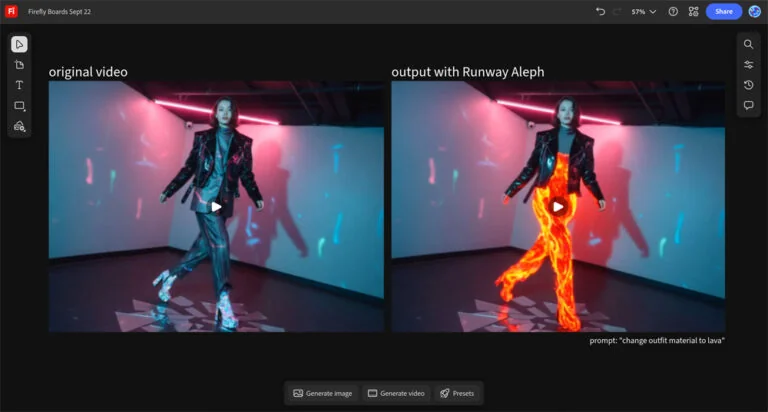
On 25 July 2025, Runway published a research page introducing Aleph, which it calls a state-of-the-art in-context video model built for editing footage that already exists rather than generating a new clip from a text prompt alone. The announcement lists the model's target tasks as adding, removing, and transforming objects in a shot, generating a different camera angle of the same scene, and modifying style and lighting, all operating on footage a user supplies, such as a take from a live-action shoot or a previous generation.
What the documents show
Runway's own announcement states Aleph became available for all paid users at launch, but names no quantified accuracy figures, failure rates, or comparison against a prior tool; its examples are the company's own selected demonstrations, a promotional showcase rather than an independent test. The more instructive document is Runway's prompting guide for the current Aleph 2.0 model, which describes the mechanism plainly: an editor edits one frame and Aleph 2.0 modifies the rest of the video to match, changing only what is asked for while preserving everything else, including background, lighting, and surrounding details. That is a specific technical claim about how edits propagate, distinct from a general promise that any requested edit will look seamless.
The workflow
Runway packages Aleph 2.0 inside a tool called Edit Studio, whose own documentation sets concrete technical limits: uploaded video must run between 2 and 30 seconds, hold between 24 and 30 frames per second, sit at 480p to 1080p, and contain no more than ten cuts before the tool returns an error. An editor selects a single keyframe from the uploaded clip, describes the desired change as a short text prompt, the guide's own examples include changing a background to ancient city ruins or changing an outfit to a bright yellow fur coat, previews the resulting still, and only then generates the full-clip edit, optionally adding a separate motion prompt for movement the source footage does not already contain.
What the tool does not change
Neither document claims Aleph removes the need to review a generated edit against the rest of a cut: the workflow itself is built around previewing a single edited keyframe before committing to a full-clip generation, which only makes sense if a human is expected to judge that preview. The technical ceilings Runway documents, a 30-second maximum, a ten-cut limit, a fixed resolution band, mean an editor still decides how to break a longer sequence into pieces Aleph can process, and still checks that an edit holds together once cut back into a finished timeline.
- Does the requested edit fall within Aleph's documented length, resolution, and cut-count limits?
- Was the previewed keyframe actually representative of the whole shot's motion and lighting?
- Is an edited clip being treated as a finished shot, or still a candidate awaiting review against the cut?
Aleph is documented as an editor of existing footage with named technical ceilings, not an unconstrained image-to-anything tool. Its own prompting guide, more than its launch announcement, is where the real operating boundaries live.
Sources & reading trail
Runway's own research announcement describing Aleph as an in-context video model for editing existing footage, with supported edit types and availability.
Source published: 25 July 2025 · Retrieved: 16 September 2026
Runway's own help-center guide describing how Aleph 2.0 edits one keyframe and propagates the change while preserving background, lighting, and other details.
Source published: Not established · Retrieved: 16 September 2026
Runway's own documentation of Edit Studio's technical limits for Aleph-based edits: clip length, resolution, frame rate, and cut-count ceilings.
Source published: Not established · Retrieved: 16 September 2026
Documentation, agreements and rulings establish the note; the workflow reading is Screen Method editorial analysis. This retrospective draft does not imply the site published on the event date.