
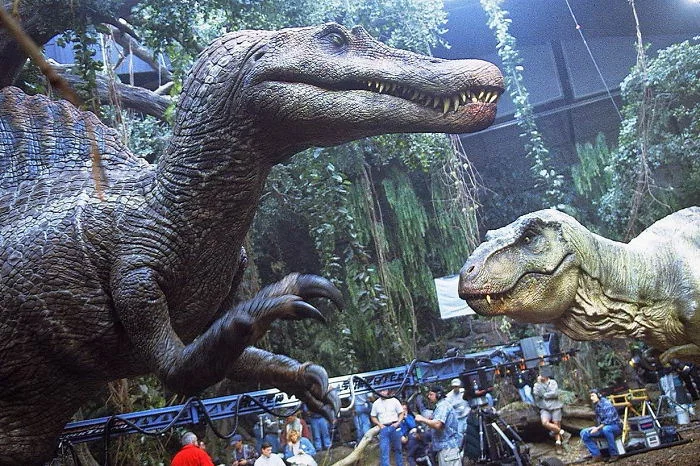
The shot
In Jurassic Park (1993), a herd of Gallimimus and a towering Tyrannosaurus rex shared the frame with live actors in wide daylight shots, not just glimpsed in shadow. Industrial Light & Magic's own account of the film states plainly that 'no one had put living, breathing synthetic animals in a live-action movie before; creature animation had always been mechanical and animatronic.' Steven Spielberg directed; Stan Winston built the animatronic and full-scale creatures; ILM, under visual effects supervisor Dennis Muren, built the computer-generated ones.
What the documents show
ILM's page is a verified production account describing 'fewer than 60 shots of the fully CG dinosaurs,' created after a test by CG artists Steve Williams and Mark Dippe convinced Spielberg the approach could work. A June 1993 American Cinematographer feature on the production corroborates the hybrid nature of the effects, describing a four-person creature design team and noting that even some digitally rendered dinosaurs, like the Gallimimus, were designed at Stan Winston's studio first so the CG and physical creatures would match. The Academy's own record of the 66th Academy Awards lists the film's Visual Effects Oscar as going to Dennis Muren, Stan Winston, Phil Tippett and Michael Lantieri — crediting the animatronics supervisor and the stop-motion-turned-CG animation supervisor alongside the computer-graphics side, not a CG team alone.
The workflow
The production's own account describes a design pipeline that started with Winston's physical maquettes and sculptures, which served as reference for the digital models so a shot could cut between a physical creature and a CG one without a visible seam. Phil Tippett, originally hired for stop-motion animation, moved into directing the digital creatures' movement once the test convinced the production computer animation could carry the performance — a craft transfer the ILM account frames as central to why the dinosaurs read as animals rather than effects.
What the tool does not change
The CG dinosaurs did not replace the physical ones; ILM's own count of fewer than 60 fully computer-generated shots, against a film built around dinosaurs throughout, shows the production used computer graphics for specific shots animatronics could not achieve, not as a wholesale substitute. The judgment about which shot needed which technique, and the design continuity between a sculpted maquette and a digital model, stayed with the animators and Winston's team.
- How many of a production's creature or character shots are actually fully generated, versus generated for select shots within a physically built performance?
- Does a generated-creature demo show continuity with a designed, physical reference, or does it originate the design itself?
- Who is credited for the animation judgment behind a generated performance, and what is their background?
The lasting reference point in Jurassic Park is not that computer graphics replaced physical effects, but that a production used both together, deliberately, credited both in the same Academy Award, and kept the design decisions with the same animators and craftspeople throughout.
Sources & reading trail
ILM's own account of the production, the fewer-than-60-shot count for fully CG dinosaurs, and the test that convinced Spielberg.
Source published: Not established · Retrieved: 16 September 2026
The Academy's own record of the Visual Effects Oscar naming Muren, Winston, Tippett and Lantieri together.
Source published: Not established · Retrieved: 16 September 2026
American Cinematographer's June 1993 account of the hybrid animatronic-and-digital creature design pipeline.
Source published: 1 June 1993 · Retrieved: 16 September 2026
Documentation, agreements and rulings establish the note; the workflow reading is Screen Method editorial analysis. This retrospective draft does not imply the site published on the event date.