
The word custom hides a source decision
Adobe's 19 March announcement describes Custom Models alongside new Firefly image and video capabilities; its January Foundry announcement describes models tuned with a company or IP owner's proprietary brand or franchise content. Those are vendor descriptions, not an assurance that any particular asset is cleared, representative, or safe to reuse. For a filmmaker, the important decision precedes the model: which material is actually authorized to define a project's look? A pitch deck can contain borrowed frames, a scout can contain a private home, and a character board can include a performer who has not consented to synthetic reuse. Calling the collection a ‘style’ does not remove those distinctions. Create a bounded source room before experimentation begins, rather than treating every image that has reached the art department as training or reference material. [s1] [s2]
Build the source room around provenance and purpose
For every candidate item, record origin, rights or permission status, contributor, allowed task, and removal trigger. Separate director-owned references, commissioned production art, licensed material, actor likeness material, and inspiration that cannot be supplied to a model. The allowed task matters: a frame cleared to inform a private treatment may not be cleared to generate campaign variants or to stand in for a performer. C2PA 2.4, published in April 2026, added an AI Disclosure Assertion and a JSON representation for evaluation and reporting. It does not solve clearance, but it is a useful reminder that an output description and a source record are separate things. The source room is the human record that says what went in and why; a credential, where available, is a technical provenance record with its own scope. [s1] [s3]
Use a release gate rather than a permanent library
Start with a small, reviewed subset and attach an expiry rule to material that can change: cast references expire with cast changes; client assets expire when the campaign approval ends; location imagery expires if the agreement is limited. Before a model output joins a board, note which approved source set was in force and who approved the task. Before it joins an edit, check that it still fits the brief and any performer, brand, or location limits. The January Foundry post is explicit that its account concerns IP-owner content and creative control; Screen Method's recommendation is to make that control concrete with a source-room gate. This turns ‘custom’ from a vague creative promise into an inspectable production boundary. [s2] [s3]
What a source room cannot promise
A source room cannot determine copyright, contract interpretation, consent validity, model retention, or downstream platform treatment. Those questions require the applicable agreements, owners, and sometimes specialist advice. Nor does it prove that a model will reproduce a look consistently or avoid undesirable associations. Its benefit is operational: it stops an unreviewed reference from acquiring authority simply because it was easy to upload. This is editorial guidance drawn from the cited 2026 product and technical documents, not a claim that Adobe's products create or enforce this procedure. [s1] [s2] [s3]
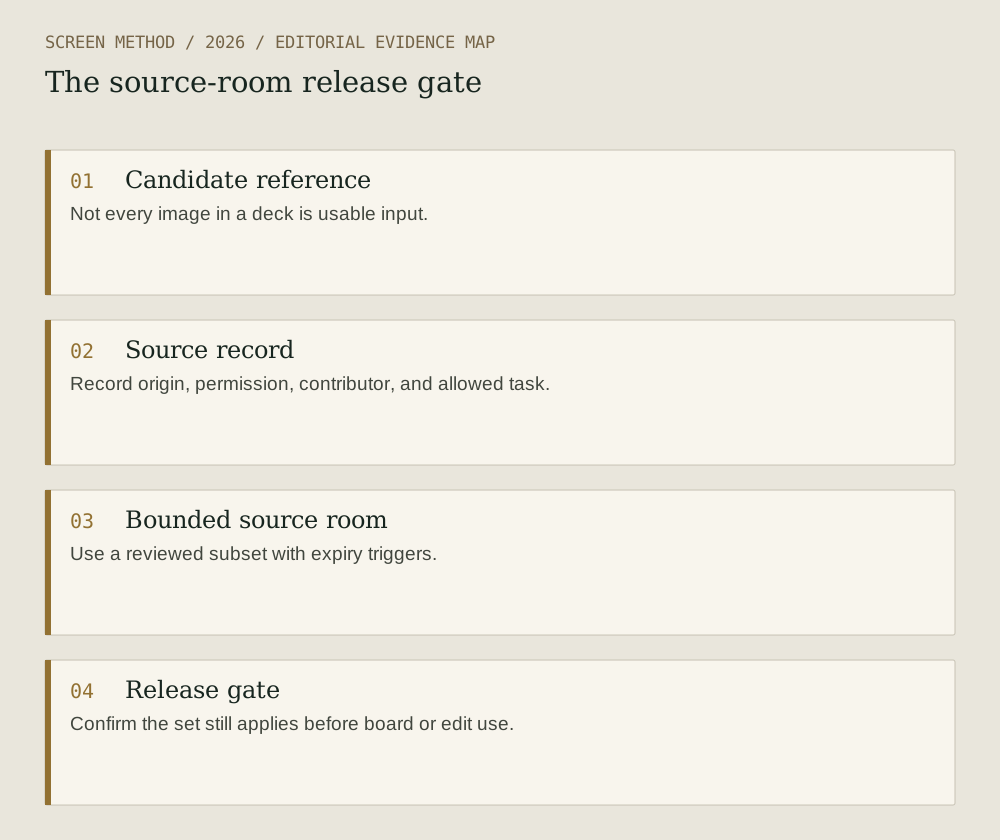
Diagram provenance
Original Screen Method editorial diagram, prepared 2026-09-19 from the cited evidence. This is an explanatory synthesis, not a product interface, documentary image or test result. No third-party artwork copied; no external image permission required for this drawing.
- Candidate reference Not every image in a deck is usable input.
- Source record Record origin, permission, contributor, and allowed task.
- Bounded source room Use a reviewed subset with expiry triggers.
- Release gate Confirm the set still applies before board or edit use.
Sources & limits
Not legal advice or a rights audit. No claim is made that Custom Models, Foundry, or C2PA validate the permissions or representativeness of a source set.
- Adobe — Adobe Firefly expands video and image creation with new AI capabilities and custom models
Source date: 2026-03-19. Retrieved 2026-09-19. Adobe's 2026 Custom Models announcement.
- Adobe — Adobe partners with artists to power the new era of media & entertainment with Firefly Foundry
Source date: 2026-01-22. Retrieved 2026-09-19. Adobe's Foundry description of tuning on proprietary brand or franchise content.
- Coalition for Content Provenance and Authenticity — C2PA Technical Specification 2.4
Source date: 2026-04-01. Retrieved 2026-09-19. 2.4's AI Disclosure Assertion and reporting-oriented crJSON additions.
Preparation: 2026-09-19. Site publication: not yet published. Source dates are not publication dates for this article.