
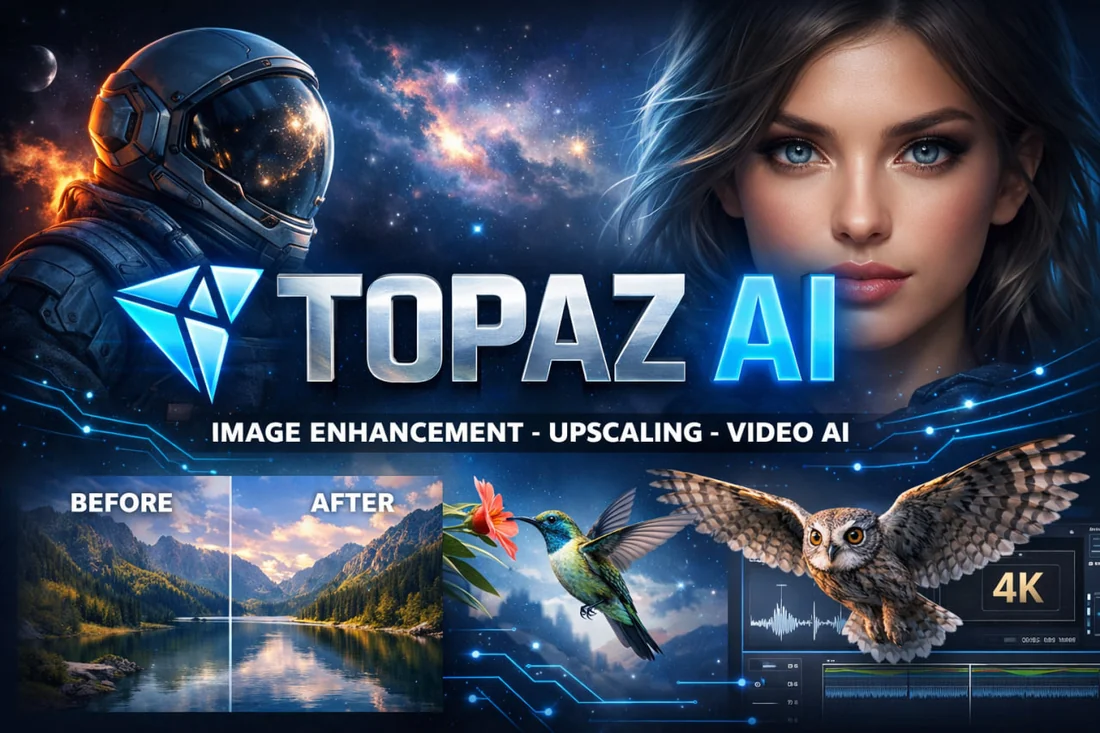
The shot
Topaz Video AI, now marketed as Topaz Video, is a standalone desktop application scoped, by the company's own quick-start guide, to restoration and delivery tasks rather than shot creation: upscaling, denoising, stabilization, frame interpolation, motion deblur, grain, and SDR-to-HDR conversion. It targets footage that already exists, an old master, a compressed web download, a shaky handheld pass, not generating new frames from a prompt. Retrieved 16 September 2026, the documentation names specific AI models for each task, letting an editor pick a model rather than relying on one automatic filter.
What the documents show
The company's own enhancement documentation draws a distinction that matters for anyone treating the output as a faithful record of the source: some models generate new image information during upscaling, while others are explicitly conservative. One high-resolution mode, it states, runs at 2x mode to increase resolution and generate detail in addition to noise reduction; the company's own word is generate, not recover. By contrast, a named restoration-leaning model will not remove film hairs and scratches or generate details, adding that as a conservative model it aims to preserve the original source intent. Separately, the Starlight series documentation states its newer, higher-end models are diffusion-based, a generative method distinct from the faster models in the same application. This is the vendor's own technical documentation, not an independent measurement of how much of an upscaled frame is invented.
The workflow
An editor imports a clip, previews it at the frame or full-video level using the application's Frame Preview, Live Render, or Render Preview modes, and selects a named model matched to the footage and the desired trade-off between speed and detail generation. A conservative model suits a delivery master where fidelity to the original negative matters; a detail-generating model suits a heavily degraded source intended for a large screen, where some invented texture may be preferable to visible softness. Diffusion-based Starlight models render substantially slower, Topaz's own documentation warns processing can range from several minutes to multiple days, and they require an added local or cloud rendering component.
What the tool does not change
The documentation does not claim any of these models restore what a damaged frame originally contained; it describes some of them as adding plausible new detail, which is a different claim from recovery. Deciding whether that trade-off is acceptable for a restoration, a delivery master, or a stylized upscale remains an editorial, and for archival work an ethical, judgment the software does not make. Choosing between a conservative and a generative model, and disclosing which was used, stays with the person operating the tool.
- Is this pass a restoration, where invented detail is unacceptable, or a stylized upscale, where it is not?
- Which named model was used, and is that documented for the delivery record?
- Does the client or archive know that some frames may contain generated detail?
Topaz's own documentation already contains the caution that matters most: some of its models are built to generate detail, not recover it, and the two are not interchangeable claims about a restored image.
Sources & reading trail
Topaz's own documentation distinguishing enhancement models that generate new detail on upscaling from a conservative model that avoids doing so to preserve source intent.
Source published: Not established · Retrieved: 16 September 2026
Topaz's own overview of the application's scope: upscaling, denoising, frame interpolation, stabilization, and format conversion, not shot generation.
Source published: Not established · Retrieved: 16 September 2026
Topaz's own note that its Starlight model family is diffusion-based, distinguished from its faster, non-diffusion enhancement models.
Source published: Not established · Retrieved: 16 September 2026
Documentation, agreements and rulings establish the note; the workflow reading is Screen Method editorial analysis. This retrospective draft does not imply the site published on the event date.