
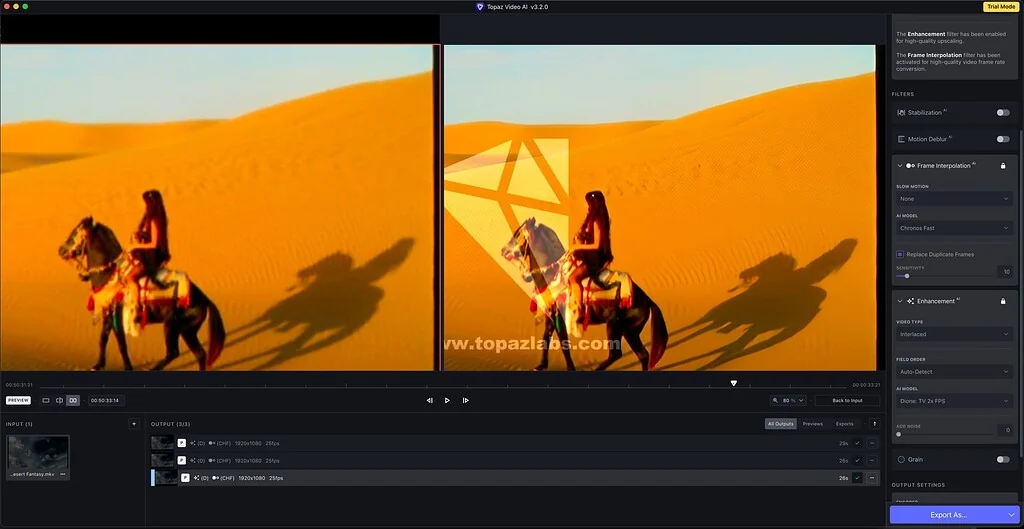
The shot
A degraded shot going through AI-based restoration is a generation problem hiding inside what looks like a repair job. Topaz Labs' own documentation, the Topaz Video docs as retrieved on 16 September 2026, describes a family of diffusion-based 'Starlight' models, including Starlight Mini, Sharp, Fast 2 and HQ, that sit inside Topaz Video alongside older, non-generative enhancement models such as Iris.
What the documents show
The documentation states plainly that 'the Starlight models are diffusion-based, which means they process significantly slower than core enhancement models regardless of hardware,' distinguishing them explicitly from non-generative tools. In the Starlight Series documentation, for Starlight Fast 2 and Starlight HQ, the docs list, under a heading reading 'this model is less ideal for content with,' specific documented weaknesses: 'haloing issues common with vintage digital videos,' hair detail that 'can vary... when content is on the lower medium spectrum,' and, notably, that 'small repeated patterns can flicker.' That last item is the vendor's own description of a generation-specific failure: because a diffusion model re-synthesizes plausible texture on each frame rather than copying fixed source pixels, a repeating pattern can be resolved slightly differently frame to frame, producing instability that traditional, non-generative interpolation does not introduce. This is the vendor's own documented limitation, not an independently measured failure rate; no cited document here states a numeric error rate.
The workflow
As the documentation describes it, an editor applies a Starlight model for heavily degraded or low-resolution footage, then uses a 'Recover Detail' slider, described as controlling 'how much original source detail will be mixed back into the enhanced footage,' to balance invented texture against the original plate. The docs also describe stacking two enhancement passes, called Second Pass Enhancement, for complex restoration work, and note that all diffusion models require a local or cloud rendering component called Neuroserver.
What the tool does not change
A 'Recover Detail' control exists precisely because the underlying process is generative rather than a lossless reconstruction: the documentation does not claim the Starlight family recovers detail that was actually recorded, only that it can add texture consistent with what the source plausibly looked like. Deciding whether that invented detail is acceptable for a specific deliverable, a restoration credit, or an archival claim remains an editorial and legal judgment the vendor documentation leaves entirely to the person running the job.
- Does your deliverable require verifiably recorded detail, or is plausible-looking restoration acceptable for this use?
- Which Starlight variant's documented weaknesses, such as flicker on repeated patterns, match the footage you are restoring?
- How much 'Recover Detail' are you mixing back, and have you disclosed that a generative pass touched the shot?
Generative upscaling and traditional interpolation are not the same operation even when both are labeled 'enhancement'; Topaz's own documentation draws that line, and a production crediting a restored shot should draw it too.
Sources & reading trail
Describes the Starlight diffusion model family, the Recover Detail control, and Second Pass Enhancement workflow.
Source published: Not established · Retrieved: 16 September 2026
States the diffusion-based processing model, the Neuroserver requirement, and per-model documented weaknesses like flicker on repeated patterns.
Source published: Not established · Retrieved: 16 September 2026
Documentation, agreements and rulings establish the note; the workflow reading is Screen Method editorial analysis. This retrospective draft does not imply the site published on the event date.