
The shot
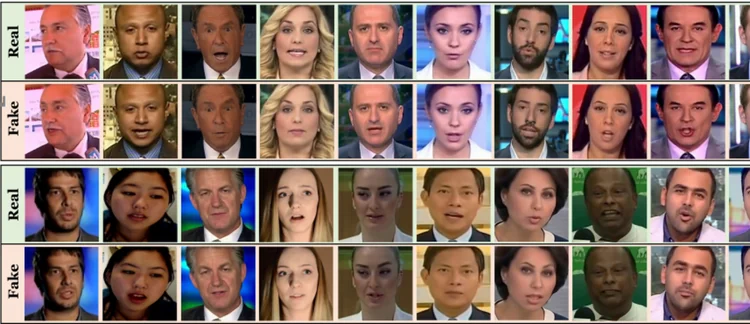
In September 2019, Facebook, described on the company's own page as having 'partnered with other industry leaders and academic experts,' launched the Deepfake Detection Challenge, pairing a purpose-built dataset with a public Kaggle competition. Unlike the generation benchmarks elsewhere in this file, the DFDC measured the opposite skill: how accurately a model can catch manipulated video, not how convincingly it can make one.
What the documents show
According to Meta's own dataset page, the effort produced a 5,000-clip preview set and a full dataset of 124,000 videos, built with paid actors who 'entered into an agreement to the use and manipulation of their likenesses.' The accompanying dataset paper states that 2,114 teams entered the competition and that 60 percent of final submissions scored a log-loss no better than guessing a 0.5 probability for every video, evidence that detection was, in the authors' own words, 'extremely difficult.' The paper reports the winning submission reached an overall log loss of 0.4279 on the 10,000-video private test set, and that the best-performing models, evaluated on real, unaltered videos alone, achieved an average precision of 0.753 and an ROC-AUC of 0.734, which the authors present as evidence that training on DFDC 'can generalize to real in-the-wild Deepfake videos.' This is the organizers' own reported result on their own dataset and competition, not an outside audit of detector performance in production use.
The workflow
As the dataset paper documents it, the top five entries combined face-detection preprocessing with convolutional networks like EfficientNet and Xception, ensembling several models and augmentation strategies rather than relying on one architecture. A team building a moderation pipeline today would use this only as a starting methodology, since the paper's own numbers describe detector performance against 2019-era manipulation methods, not any generation model released since.
What the tool does not change
The paper is explicit that even its best detector's precision was measured on a curated private test set, not on the highly imbalanced real-world traffic the authors describe, where genuine deepfakes may be rarer than one in a million videos; they state directly that under that imbalance, 'accuracy is not as relevant as the precision or false positive rate.' Judging whether a specific suspect clip is manipulated, and what to do about it, remains a human review decision the dataset does not automate.
- Was a detection accuracy claim measured on the DFDC's curated test set, or on manipulation methods that postdate it?
- Does the claim account for how rare genuine manipulated videos are in your actual traffic, not just in a balanced test set?
- What consent and likeness terms did the underlying training data carry, per the dataset's own disclosure?
The DFDC remains a landmark because of its scale and its transparent reporting of how hard detection was in 2019; extending its reported accuracy figures to today's detectors, trained against newer generation methods entirely, is a claim the dataset paper never makes.
Sources & reading trail
States the September 2019 launch, the organizing coalition, and the dataset's scale and consent terms.
Source published: Not established · Retrieved: 16 September 2026
Reports competition scale, the winning log-loss score, and best-reported precision and ROC-AUC on real videos.
Source published: 12 June 2020 · Retrieved: 16 September 2026
Documentation, agreements and rulings establish the note; the workflow reading is Screen Method editorial analysis. This retrospective draft does not imply the site published on the event date.