
The useful fact in the case study is the order of work
Adobe's 30 January Sundance account says Taryn O'Neill's MythOS team shot actors on green screen and composited them with AI backgrounds. The team prepared the AI video backplates before the stage shoot so performers could be lit and grounded in those environments. That is a production lesson with more value than a generic claim that AI makes VFX faster. A generated environment may be flexible in post, but it still establishes direction of light, horizon, scale, eyeline, camera height, atmosphere, and blocking choices that a crew must interpret on the day. Adobe's account is commissioned vendor reporting, not an independent behind-the-scenes audit; it nevertheless describes a named workflow on a named short and identifies the order in which the team made its decisions. [s1]
Turn the environment into a stage brief
Before shooting, create one page per planned composite: approved backplate or the strongest provisional version; lens and framing target; horizon and eyeline; key and ambient light direction; contact-shadow expectation; actor marks; and the planned degree of camera movement. Mark every unresolved item in a different colour. The goal is not to freeze the generated image as a final plate. It is to make the on-set assumptions visible enough for the director, cinematographer, performer, and VFX supervisor to challenge. Adobe's January Foundry post makes broad claims about using generative systems through pre-, on-set, and post-production; the practical correction is to give each stage a specific, reviewable brief rather than treating the same prompt material as sufficient for all three. [s1] [s2]
Separate a likeness reference from a general character reference
Adobe reports that MythOS created wide and over-the-shoulder actor shots in AI using likeness cards, with the actors' consent, made from angle and expression references in wardrobe. That detail should trigger a separate record from the environment brief. Identify the person, the approved source images, the permitted shot types, the project, the review authority, and the withdrawal or revision path. Do not let a broad style board become an implicit authorization to make a person appear in new shots. The case study itself says the production combined traditional and generative methods, a reminder that a hybrid workflow has more handoffs to document, not fewer. This is a production-control recommendation, not a conclusion about the adequacy of MythOS's arrangements. [s1] [s3]
The case does not generalize a clearance process
One vendor-published case cannot establish typical schedules, budgets, consent standards, or the reliability of the cited tools. It also cannot tell another production which permissions it needs. Its strongest transferable point is narrow: generated worlds should become an explicit shooting input before a live-action day, and any use of a person's likeness should be handled as its own decision trail. A director can retain flexibility by planning versioned backplates and shot contingencies; flexibility is more useful when the team knows which version informed the light and performance. [s1] [s2] [s3]
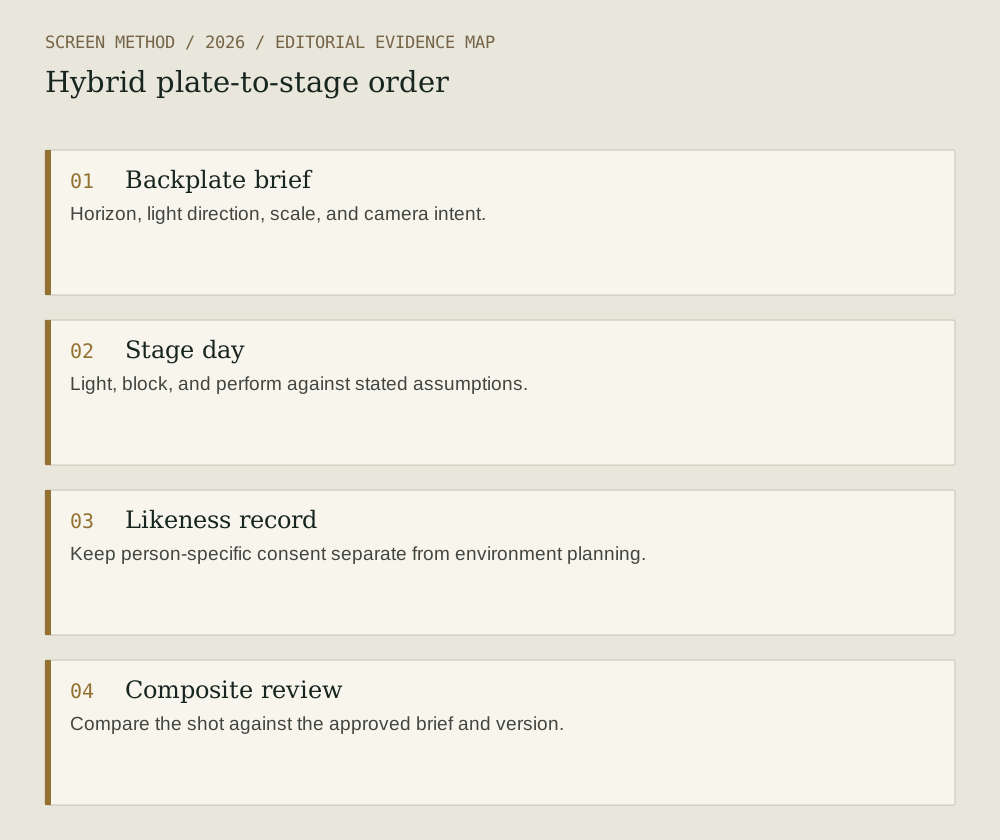
Diagram provenance
Original Screen Method editorial diagram, prepared 2026-09-19 from the cited evidence. This is an explanatory synthesis, not a product interface, documentary image or test result. No third-party artwork copied; no external image permission required for this drawing.
- Backplate brief Horizon, light direction, scale, and camera intent.
- Stage day Light, block, and perform against stated assumptions.
- Likeness record Keep person-specific consent separate from environment planning.
- Composite review Compare the shot against the approved brief and version.
Sources & limits
Vendor case study plus editorial synthesis. No claim of independent verification, actor-contract review, testing, cost saving, or a universal hybrid-production method.
- Adobe — Sundance Dispatch: Expanding creative expression in filmmaking with generative AI
Source date: 2026-01-30. Retrieved 2026-09-19. Adobe's named MythOS account: prebuilt backplates, green-screen shoot, likeness cards with consent, and late editorial changes.
- Adobe — Adobe partners with artists to power the new era of media & entertainment with Firefly Foundry
Source date: 2026-01-22. Retrieved 2026-09-19. Adobe's 2026 framing of generative activity across production stages.
- arXiv / authors — Integrating GenAI in Filmmaking: From Co-Creativity to Distributed Creativity
Source date: 2026-03-24. Retrieved 2026-09-19. The paper's framing of filmmaking as distributed work whose roles and temporalities can be reconfigured by GenAI.
Preparation: 2026-09-19. Site publication: not yet published. Source dates are not publication dates for this article.