
Four jobs, not one magic prompt
Google published an account of the generative-media sequence used to open its 2025 I/O keynote on 10 June 2025. It describes a process involving Imagen 4 for still images, Gemini to help rewrite prompts, Veo 3 to animate images, and repeated revisions to shots and audio. That is a maker’s account of one internal production, not a benchmark against other workflows.
The sequence matters because each system is assigned a different task. A still image can establish composition, place and palette. An image-to-video step must preserve enough of that choice while introducing movement. Then an editor has to judge whether the motion helps the overall sequence, and whether audio binds it to adjacent shots. The chain is only as strong as its least convincing transition.
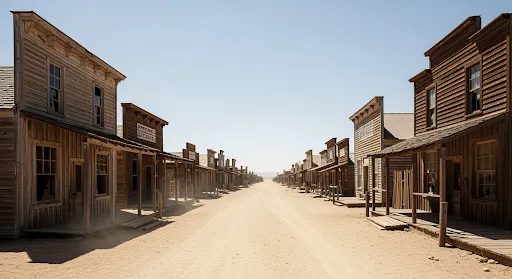
Read the empty street as a design decision
The deserted western town still is not valuable because it proves technical realism. It gives a production team a spatial question: what will move through this frame, where can a camera travel, and what should remain stable? A wide, legible street has usable depth and a clear vanishing point. If a generated camera move bends the storefronts or changes their spacing, a viewer may not name the defect but will feel the world loosen.
That suggests a practical review method. Save the approved still, the motion pass and the final edit as separate records. Compare landmarks at the start and end of the shot; mark changes as intentional or errors. Listen without looking to see whether sound implies the same space. Finally, watch the cut at normal speed. A still may look excellent in isolation while the edited sequence fails to carry direction.
What this example cannot prove
Google does not turn the case into a disclosed cost model, a success-rate study or a rights audit. The account is first-party and promotional. It is still useful for its concrete account of iteration: words became stills, stills became motion candidates, and candidates were changed for the finished film. A smaller production can borrow the order of decisions without assuming access to the same tools, team or compute budget.
For a new sequence, begin with a shot purpose rather than a model name. Decide what the audience must understand at the end of the shot. That makes it possible to reject a beautiful but irrelevant render, and to keep the person responsible for story in charge of the final selection.
Sources & context
- Google · How we used generative media at I/O 2025 (10 Jun 2025)
Source checked 16 September 2026. The process is attributed to Google; Screen Method did not independently audit prompts, outputs or labor. This retrospective article was prepared in 2026.