
Continuity is not the same as approval
Adobe's June preview says Firefly's upgraded creative studio is designed to keep assets, generations, and creative context together; its Elements feature can preserve characters, locations, and objects for reuse. For an episodic project, that is a recognisable production problem: repeating visual decisions should not require rebuilding the whole reference pack every morning. But persistence has a cost. A rough location still, an unapproved wardrobe idea, or a reference supplied only for mood can become an unspoken constraint when it is easy to reuse. Treating every saved element as approved turns a convenience feature into an unreliable source of art direction. The 2026 reader need is specific: as creative tools begin to retain context across sessions, a team needs a human-readable record of the status of that context. [s1]
Make a four-column context ledger
Use four fields beside every reusable element: owner or origin, intended use, approval status, and expiry or revision trigger. ‘Actor likeness reference; performance test only; consent and production approval required; retire after casting change’ says much more than a thumbnail labelled ‘hero’. ‘Kitchen palette; director-approved for episode two; revisit after production design lock’ prevents a board reference from masquerading as a set plan. Adobe's April AI Assistant announcement says the system is intended to maintain context across sessions and move that context into specific apps; the ledger is the independent companion to that promise. It allows a collaborator to understand what the project has remembered and whether it ought to act on it. [s2]
Review the ledger at three handoffs
Review it when an idea becomes a board, when a board becomes a shot request, and when a shot enters the edit. At the board stage, remove references that were only exploratory or that the team cannot use. At the shot stage, confirm the approved visual bible, the needed permissions, and the production constraint the image is meant to solve. At the edit stage, record the source asset, any transformation, and why the shot remains in the cut. Adobe's January account of Firefly Boards importing assets directly into Premiere illustrates why those handoffs matter: the path from ideation to timeline is shorter. A shorter path is not a weaker need for context; it is a stronger need to distinguish a suggestion from an approved instruction. [s3]
The ledger is a decision aid, not a rights system
A context ledger cannot establish ownership, consent, model-training provenance, or legal compliance. It also cannot make persistent memory technically transparent inside a vendor product. It is deliberately low-tech because its job is editorial: make the working assumptions inspectable by the people accountable for the film. Keep the ledger with the project, export it with any delivery package, and ask one person to clear retired entries at each major turn. The aim is not to document every prompt. It is to prevent a provisional decision from gaining authority merely because it was convenient to reuse. This is Screen Method's editorial procedure, inferred from documented 2026 context-preserving features rather than a claim that the products provide the ledger themselves. [s1] [s2] [s3]
A weekly cleanup prevents false continuity
Once a week, open the active board beside the ledger and ask four questions: which item is now approved; which remains exploratory; which has been superseded; and which should leave the working set altogether? Record the answer before someone starts the next sequence. A removed reference is as important as a new one: it prevents an earlier experiment from quietly returning through a saved project or shared library. If the team has no production coordinator, make the editor or director responsible for a ten-minute pass after review. Adobe's 2026 product framing makes reuse and context persistence central; this tiny ritual makes the production's own judgment equally persistent. [s1] [s2] [s3]
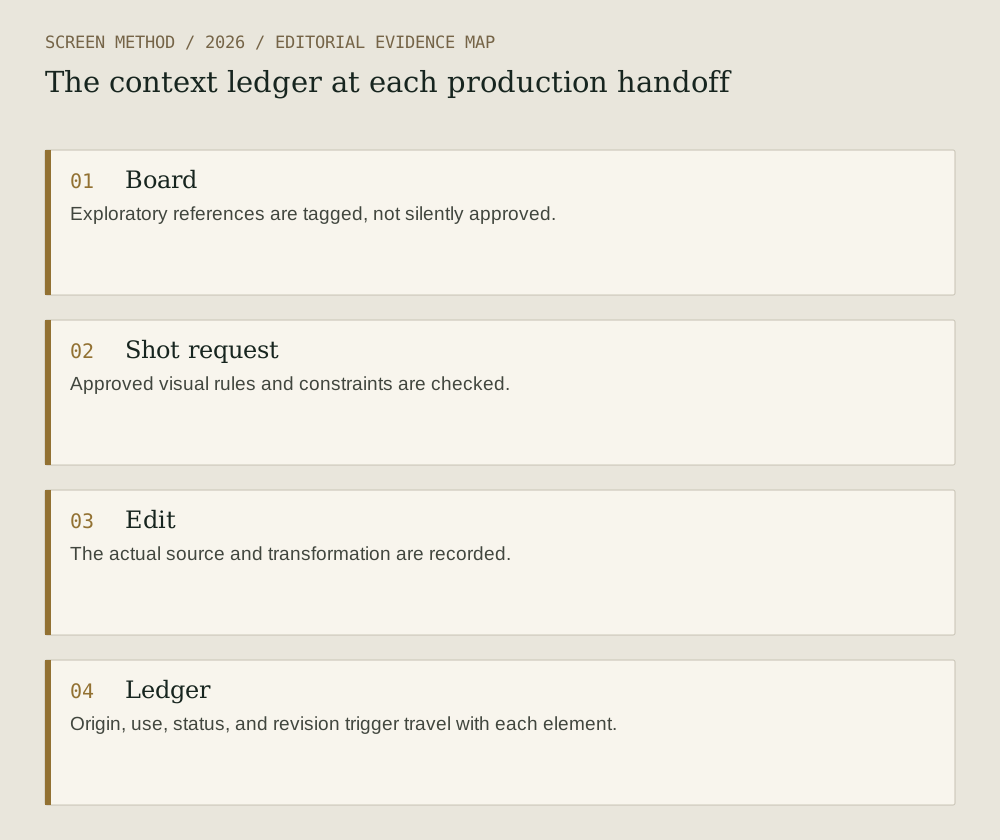
Diagram provenance
Original Screen Method editorial diagram, prepared 2026-09-19 from the cited evidence. This is an explanatory synthesis, not a product interface, documentary image or test result. No third-party artwork copied; no external image permission required for this drawing.
- Board Exploratory references are tagged, not silently approved.
- Shot request Approved visual rules and constraints are checked.
- Edit The actual source and transformation are recorded.
- Ledger Origin, use, status, and revision trigger travel with each element.
Sources & limits
Editorial synthesis; no claim of product testing, storage behaviour verification, rights clearance, or feature availability beyond the cited previews and announcements.
- Adobe — Adobe Firefly introduces new agentic capabilities and an upgraded creative AI studio built for the way you work
Source date: 2026-06-18. Retrieved 2026-09-19. The preview's Elements, Projects, reusable assets, and persistent-context descriptions.
- Adobe — Introducing Firefly AI Assistant – a new way to create with our creative agent
Source date: 2026-04-15. Retrieved 2026-09-19. Adobe's description of cross-app, session-aware creative context.
- Adobe — New AI-powered video editing tools in Premiere, plus major motion design upgrades in After Effects
Source date: 2026-01-20. Retrieved 2026-09-19. Firefly Boards-to-Premiere asset transfer in Adobe's announced workflow.
Preparation: 2026-09-19. Site publication: not yet published. Source dates are not publication dates for this article.