
There are two different transparency questions
The European Commission's Article 50 FAQ says providers of systems generating synthetic audio, image, video, or text must ensure outputs are marked in a machine-readable, detectable form. It separately says deployers must clearly label deepfakes to a natural person at first exposure, and that an embedded machine-readable mark alone cannot fulfil that disclosure obligation. The distinction matters to film teams because an output can arrive with technical provenance while the public-facing title card, programme note, or audible disclosure remains a separate deployment decision. Article 50 started applying on 2 August 2026, according to the Commission's July guidance. This is a reading of regulator guidance, not legal advice or a conclusion about a particular film. [s1] [s2]
Triage the final shot, not the software label
At picture lock, make a short table for each synthetic or manipulated sequence: what was altered; whether it resembles an existing person, object, place, entity, or event; where the audience will encounter it; and whether it could falsely appear authentic in that context. The FAQ defines a deepfake using three cumulative features, including resemblance and false appearance of authenticity. It also gives a specifically cinematic qualification: generated or manipulated background scenes, special effects, and technical pre- or post-processing in standard movie production are not likely to meet that condition. That is not a blanket exemption for filmmaking. It means context, audience expectation, and the actual depiction belong in the review record rather than a generic ‘AI used’ label. [s1]
Put disclosure in the delivery package
The final package should carry two separate fields: technical marker status and audience-facing disclosure decision. For the first, preserve the source file and note whether a machine-readable mark was present, verified, absent, or unknown after export. For the second, record the intended release territory, channel, disclosure wording or placement, and approving editor or producer. C2PA 2.4's April 2026 additions include an AI Disclosure Assertion, but a technical assertion is not an audience message and should not be represented as one. The Commission also says disclosures for artistic or fictional work should be appropriate without hampering enjoyment; that is a design constraint a production has to solve at the release boundary. [s1] [s3]
Keep the exception narrow and the record humble
The Commission guidance is detailed but it is not a private clearance opinion, and the applicability of EU law depends on facts, roles, outputs, and distribution. Do not infer that every edited shot needs an audience label, or that a machine mark proves compliance after transformations and platform uploads. Do not rely on an internal production use being closed-loop if the material later becomes final output. The practical value of the handoff is that it forces producer, post, and distribution to answer different questions before release. Escalate unclear cases to qualified advice with the actual materials and planned deployment context. [s1] [s2] [s3]
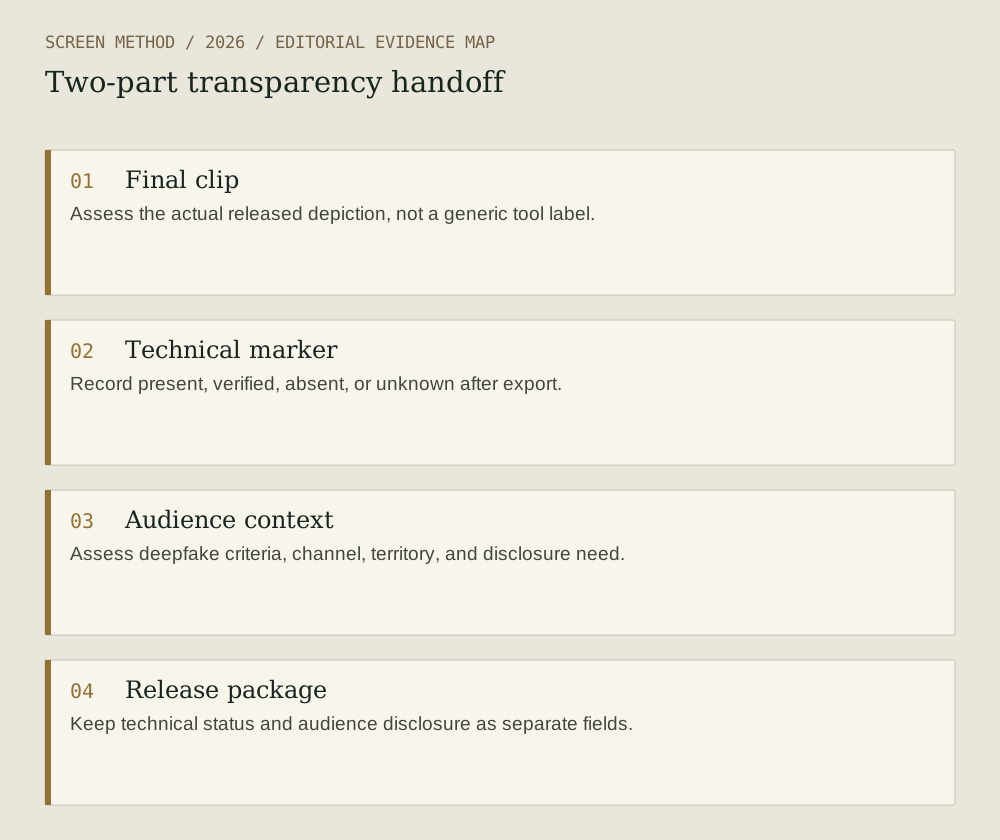
Diagram provenance
Original Screen Method editorial diagram, prepared 2026-09-19 from the cited evidence. This is an explanatory synthesis, not a product interface, documentary image or test result. No third-party artwork copied; no external image permission required for this drawing.
- Final clip Assess the actual released depiction, not a generic tool label.
- Technical marker Record present, verified, absent, or unknown after export.
- Audience context Assess deepfake criteria, channel, territory, and disclosure need.
- Release package Keep technical status and audience disclosure as separate fields.
Sources & limits
Regulatory editorial synthesis, not legal advice. The cited Commission guidance should be checked again before release decisions; this draft makes no compliance determination.
- European Commission — Transparency obligations under Article 50 of the AI Act
Source publication date not established. Retrieved 2026-09-19. Provider marking, deployer disclosure, deepfake criteria, film-production examples, artistic-work treatment, and application date.
- European Commission — Guidelines on transparency obligations for providers and deployers of AI systems
Source date: 2026-07-20. Retrieved 2026-09-19. The Commission's publication of Article 50 guidance and 2 August 2026 start date.
- Coalition for Content Provenance and Authenticity — C2PA Technical Specification 2.4
Source date: 2026-04-01. Retrieved 2026-09-19. The AI Disclosure Assertion added in the 2.4 specification.
Preparation: 2026-09-19. Site publication: not yet published. Source dates are not publication dates for this article.