
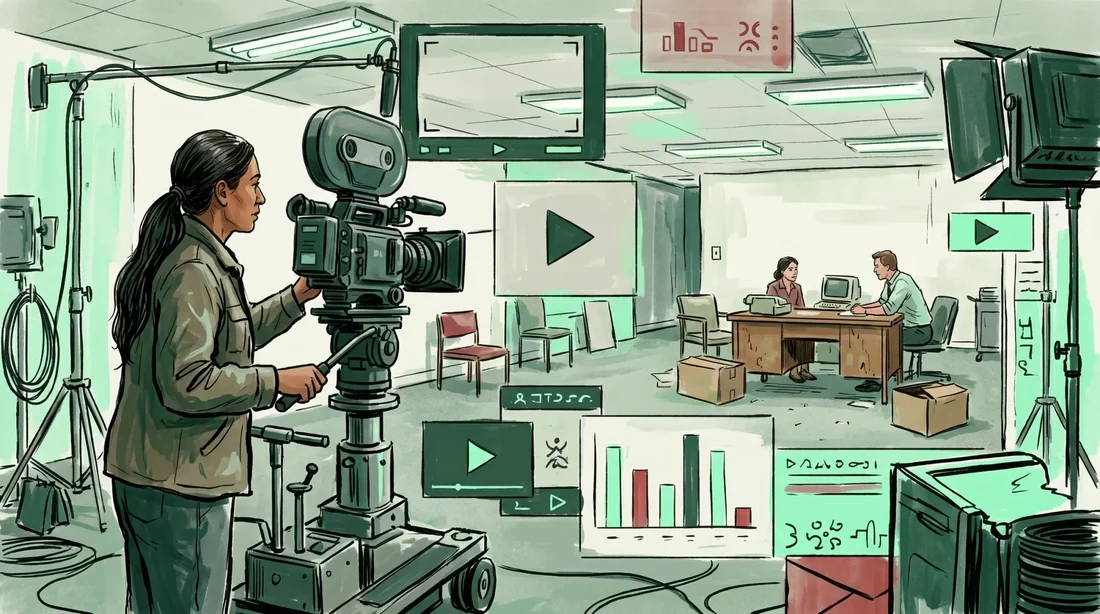
The shot
An establishing shot sets a scene's geography and scale for the coverage that follows, and it typically does not need to match a specific performer's face or a later close-up the way a matching character shot would. Runway's own Camera Terms guide documents the category directly, defining an establishing shot as one that "sets the scene by showing the location or environment" and pairing the term with a Gen-4.5 example. Google DeepMind's Veo 3.1 product page documents a related feature, described as letting a user "add ingredients to your video" by giving Veo "reference images of a scene, a character, or an object to guide its generation."
What the documents show
Runway's own FAQ on the same Camera Terms page states that static or motionless framing is harder for its model to produce reliably, and names "establishing or wide landscape shots" specifically as the case where this is most notably true -- a documented limitation for the very shot type this note examines. Veo's ingredients feature is stated as a way to guide a generation toward a given scene reference, which is a vendor capability claim rather than an independently verified account of how closely the output matches the reference. Neither page states that a generated establishing shot will match the lighting, geography, or lens character of a live-action scene shot later in the same location; both describe conditioning a single generation, not reconciling it with future footage.
The workflow
Per this documentation, an operator generates or supplies a reference image of the intended location, describes the desired camera framing using the vendor's documented shot-size and angle terms, and requests a static or slow-moving wide frame, following Runway's own recommendation to reinforce that "the camera is entirely motionless for the duration of the scene" in the prompt if a still frame is the goal. Because an establishing shot does not need to carry a specific performer's continuity, it tolerates the reference-conditioning and static-shot limitations documented above more easily than a shot requiring an exact character match would.
What the tool does not change
Neither vendor's documentation claims a generated establishing shot will automatically match a practical location scouted or built for the rest of a production, or that it removes the need for a location scout, art department reference, or a director's sign-off on scale and geography before the shot is cut into a sequence.
- Does the generated environment's geography match what later live-action coverage will show from the same location?
- Is the establishing shot meant to be static, and if so, has the vendor's own reliability caveat been accounted for?
- Would a location scout or art department reference catch a mismatch this generation would not?
An establishing shot is, by the nature of its job in a sequence, one of the more forgiving uses of a generated environment described in this documentation, precisely because it asks the tool for less than a matching character shot would.
Sources & reading trail
Vendor definition of an establishing shot and the vendor's own FAQ caveat that static, wide, and establishing shots are the hardest to produce reliably.
Source published: Not established · Retrieved: 16 September 2026
Vendor product page describing scene-, character-, and object-reference conditioning ('ingredients') as a guide for generation.
Source published: Not established · Retrieved: 16 September 2026
Vendor documentation stating that a reference image defines composition, subject matter, lighting, and style for a generation.
Source published: Not established · Retrieved: 16 September 2026
Documentation, agreements and rulings establish the note; the workflow reading is Screen Method editorial analysis. This retrospective draft does not imply the site published on the event date.