
The shot
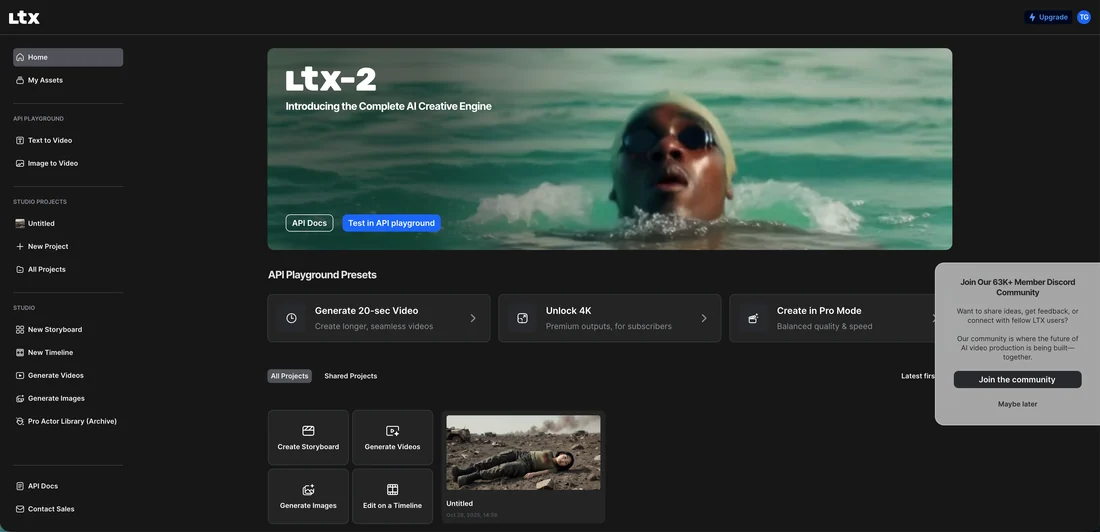
LTX Studio is a browser-based tool built by Lightricks that is meant to take a project from a script or concept through shot planning to generated scenes inside one platform, aimed at narrative and branded video production rather than single-clip generation. The company's own site describes four entry points into a project — starting from a script, a concept, an image, or a video — feeding into shared storyboard, timeline, and consistency tools.
What the documents show
LTX's own product page states a user can 'upload your script to instantly generate scenes and storyboards,' and separately lists a 'Dynamic Storyboard,' a 'Timeline Editor,' and 'Sound Design' as the tools carrying a project from planning into finished cuts. It also names 'AI Characters, Objects, Locations, and Other components' as the mechanism for keeping elements consistent across scenes. A named testimonial from a filmmaker praising the tool's speed is a vendor-selected endorsement, not an independent review. Its parent company's own site frames the broader product line as an 'Open Creativity Stack' meant to 'put creators in control,' the company's own positioning rather than a demonstrated production outcome. A stated constraint in LTX's own FAQ is that the platform 'is designed for desktop use and is not currently available on mobile.'
The workflow
Per the company's own description, a user chooses a starting point — script, concept, still image, or existing video — and the system generates an initial set of scenes and storyboard frames from it. From there, camera movement, keyframes, and reference images are used to direct individual shots, while preset visual styles are offered to keep a look consistent while iterating. The same project moves into a timeline editor for assembly and a sound-design step, with characters, objects, and locations reused across scenes rather than regenerated independently each time, according to the company's own feature list.
What the tool does not change
Nothing in LTX's own materials claims the system chooses a story's structure or a scene's dramatic intent; a user still supplies the script or concept and directs camera, keyframe, and style choices shot by shot. The desktop-only constraint means a production still depends on access to a specific computing environment rather than working from any device. The company's own 'creators in control' framing is a stated design intent, not an independent measurement of how much creative control survives in practice on a specific production.
- How much manual correction does a scene generated directly from a script actually require before it is usable?
- What happens to character or location consistency across a long-form project rather than a short promotional piece?
- Which named testimonial claims are the vendor's selection, and which reflect a documented, credited production?
LTX Studio's own documentation supports a specific, narrower claim than 'AI makes the film': a script or concept can generate a first pass at scenes and storyboards inside one connected pipeline, with camera, consistency, and editing tools that still require a person to direct each shot.
Sources & reading trail
Lightricks' own description of the script-to-scene pipeline, its storyboard and timeline tools, consistency features, and desktop-only constraint.
Source published: Not established · Retrieved: 16 September 2026
The parent company's own framing of its product line as an 'Open Creativity Stack' meant to keep creators in control.
Source published: Not established · Retrieved: 16 September 2026
Documentation, agreements and rulings establish the note; the workflow reading is Screen Method editorial analysis. This retrospective draft does not imply the site published on the event date.