
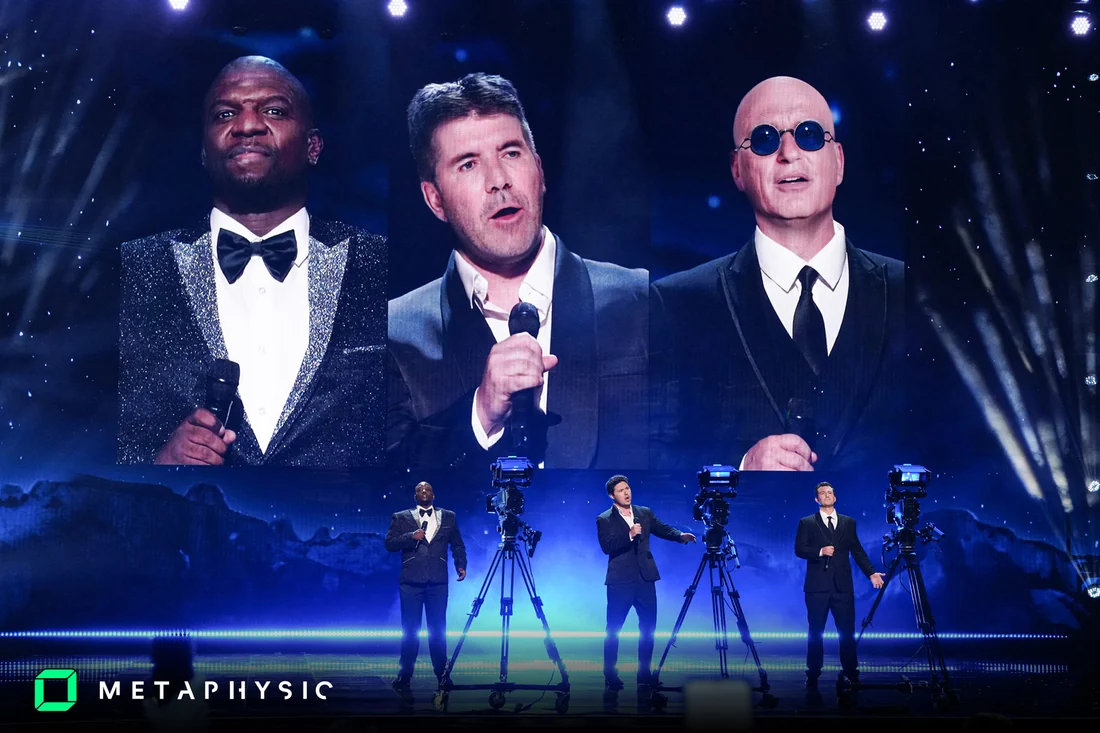
The shot
'Here,' Sony Pictures' own synopsis confirms, reunites director Robert Zemeckis and writer Eric Roth with stars Tom Hanks and Robin Wright, telling a story that spans decades from a single fixed camera position. To show the same actors across a wide span of ages within that constraint, the production used a real-time generative de-aging system built by the visual-effects technology company Metaphysic, credited on the studio's own account of the project and, per Metaphysic's news page, first reported publicly by the Hollywood Reporter on 30 August 2024, ahead of the film's 1 November 2024 release.
What the documents show
Metaphysic's own case page states that visual-effects supervisor Kevin Baillie approached the company to 'digitally recreate multiple actors at different ages,' and that the team trained separate neural-network models for each actor, developing five distinct ages for Tom Hanks alone. This is the vendor's own account of a named, credited, released production, which makes it verified production use in the sense that the film exists and Metaphysic's role is publicly credited, while specific technical claims, such as the '4K-standard' resolution Metaphysic states it delivered on set, remain the company's own description rather than an outcome an outside party has independently measured.
The workflow
Metaphysic describes a 'youth mirror' system: a camera and monitor setup letting actors see a de-aged version of their own performance in near-real time, with what the company states was roughly a two-frame delay, which it says became part of how performers adjusted their acting during a take. The company states it supplied Zemeckis with both the raw camera feed and the digitally altered feed simultaneously, so directing decisions were made against the same footage that would appear in the finished film, rather than against a placeholder to be replaced entirely later in post-production.
What the tool does not change
Metaphysic's own account describes artists 'constantly refining the models, correcting eyelines, and adjusting the emotional amplitude of each performance,' meaning the system supplemented rather than replaced a visual-effects team's ongoing judgment calls shot by shot. Casting, the actors' original performances, and Zemeckis's directing choices are described throughout as the human decisions the tool was built to support on set, not steps the company claims to have automated.
- Is a specific visual-effects claim credited to a named vendor on a named, released production, or offered without either?
- Does the vendor's account distinguish what happened on set from what its marketing materials claim in general?
- Who is described as making the final creative call on a shot: a director and supervisor, or the tool itself?
Metaphysic's own materials are a company's account of its own work, not an independent technical audit, but they are tied to one named, released, credited film rather than to an unlabeled demo reel, which is the distinction that matters most in weighing them.
Sources & reading trail
The vendor's own account of building a real-time 'youth mirror' system and training five-age models for Tom Hanks, with VFX supervisor Kevin Baillie and director Robert Zemeckis.
Source published: Not established · Retrieved: 16 September 2026
Confirms via its own reference to Hollywood Reporter's coverage that the CAA partnership and the Here de-aging work were revealed together, ahead of the film's release.
Source published: Not established · Retrieved: 16 September 2026
The studio's own synopsis credits director Robert Zemeckis, writer Eric Roth, and stars Tom Hanks and Robin Wright.
Source published: Not established · Retrieved: 16 September 2026
Documentation, agreements and rulings establish the note; the workflow reading is Screen Method editorial analysis. This retrospective draft does not imply the site published on the event date.