
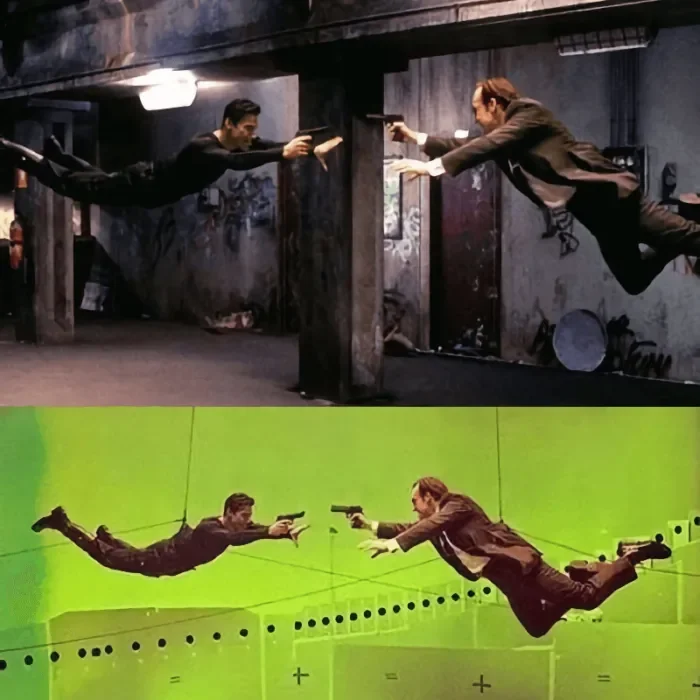
The shot
In The Matrix (1999), Neo bends backward as bullets slow to a crawl and the camera appears to circle him — a move no physical camera could make at that speed. American Cinematographer's own account of the production, published in its April 1999 issue, quotes cinematographer Bill Pope describing an earlier, abandoned plan: 'we looked into the idea of a rocket camera, which we were going to shoot across the set at something like 100 mph while filming at 150 fps, but visual effects supervisor John Gaeta came up with a different process.' That process is what the Wachowskis named 'bullet time.'
What the documents show
The magazine's account is a verified production record from the film's own cinematographer, though it defers technical detail on the effect itself to a companion piece it says ran in the same issue. The Academy of Motion Picture Arts and Sciences' own record of the 72nd Academy Awards lists The Matrix as the Visual Effects winner, crediting John Gaeta, Janek Sirrs, Steve Courtley and Jon Thum. A separate VFX Voice retrospective describes the effect plainly as '20 cameras freezing Neo mid-dodge,' an array rather than any single high-speed camera. None of these documents describe the technique as anything other than a physical rig staged for one recorded moment.
The workflow
Pope's account describes a production that rejected a literal high-speed camera move in favor of a staged effect built for a specific shot, planned during preproduction alongside the film's live-action photography rather than added afterward. The American Cinematographer piece situates this within a production that used two full camera units and extensive practical lighting rigs for its other sequences, suggesting the bullet-time setup was one bespoke solution built for one category of shot, not a general-purpose replacement for coverage.
What the tool does not change
The array did not decide where Neo would dodge or how the scene should be blocked; Pope's account makes clear the choreography and camera path were designed first, with the rig engineered afterward to execute a move that conventional coverage could not. The Academy's award went to named visual-effects supervisors for a credited film, not to a general capability that any production could apply unchanged.
- Was a specific rig or setup built for this one shot, or is a vendor describing a general capability?
- Does the cited account describe a planned, staged effect, or an automated camera decision?
- Who is named as responsible for the choreography the effect executes?
The 1999 record is narrow by design: a credited team, an Academy Award, and a cinematographer's own account of a rig built to execute one planned move. That narrowness is the useful part when a later tool's marketing borrows the phrase 'bullet time' for a much broader claim.
Sources & reading trail
Bill Pope, ASC's own account of the production, naming John Gaeta and describing the rejected rocket-camera plan that preceded bullet time.
Source published: 1 April 1999 · Retrieved: 16 September 2026
The Academy's own record of the Visual Effects Oscar naming John Gaeta, Janek Sirrs, Steve Courtley and Jon Thum for the film.
Source published: Not established · Retrieved: 16 September 2026
VFX trade retrospective describing the effect as 20 cameras freezing Neo mid-dodge, an array rather than a single camera.
Source published: 14 April 2026 · Retrieved: 16 September 2026
Documentation, agreements and rulings establish the note; the workflow reading is Screen Method editorial analysis. This retrospective draft does not imply the site published on the event date.